X for Xtra unusual place name

Here in Tasmania we have lots of unusual place names. Some are:

  • Bust-me-gall Hill
  • Break-me-neck Hill
  • Swearing Bobs Plains
  • Black Charlies Opening
  • Mother Browns Bottom
  • Gelignite Creek
  • Doo Town

My dad, Bob, was on the Nomenclature Board so knew lots of unusual named places like those above.

He would always run Hobart Walking Club trips to these places especially those with Bob in the title. My brother and I would always check out the names of mountains, hills, creeks and rivers whenever we were in the car with our parents.

Up in the northern part of Tasmania, there are some towns and other landmarks relating to the bible.

  • Promised Land
  • Devil’s Gate Dam
  • Walls of Jerusalem National Park
  • Lower Beulah

But my favourite unusual place name in Tasmania is Nowhere Else. This is a locality about 8km west of Sheffield, the town of the murals. On one of our holidays as kids, I invited one of my school friends Robin to come with us. Dad photographed my brother, Robin and myself at the signpost to Nowhere Else.

 

W for West Hobart

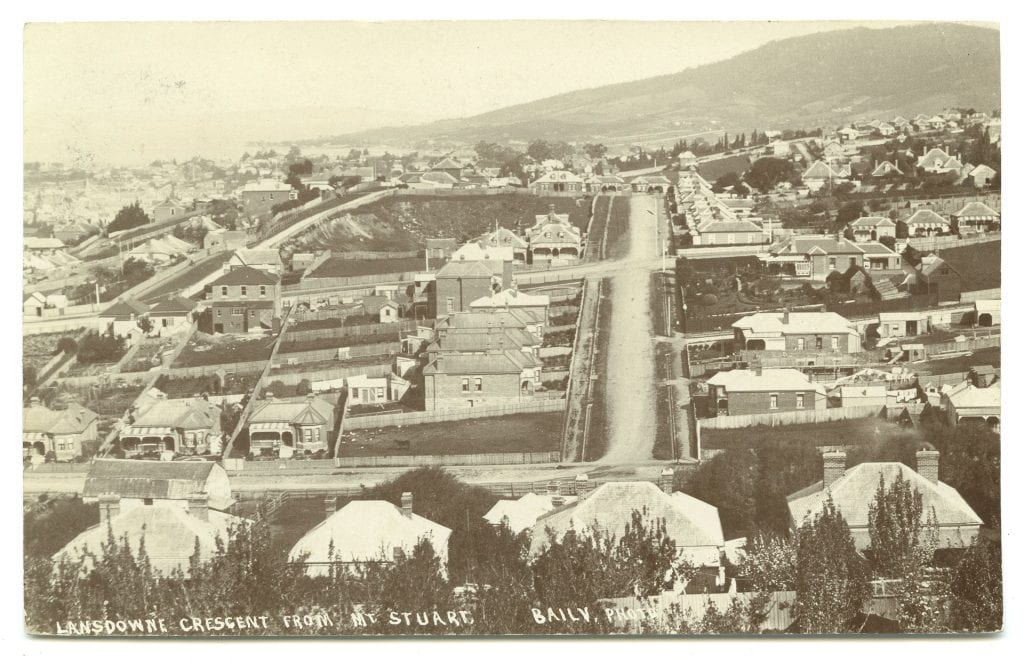
West Hobart is an inner suburb west of the city of Hobart in Tasmania. Originally it was farming land like hops, orchards, market gardens as well as poultry and dairy. But being on the foothills of kunanyi (Mt Wellington), there was also coal mining, quarrying and a brick works.

Nowadays the suburb has many artists and musicians living there. It has changed from the working class suburb from the 1960’s.

How does West Hobart relate to my family?

My father lived in Goulburn Street and went to school at Lansdowne Primary School in West Hobart.

My grandmother lived in Warwick Street while married to my step grandfather. He was a keen gardener and as a family we would often go at Christmas where he decorated a huge tree in the backyard. They also had lots of small birds and a great vegetable garden.

As kids we would often go to Knocklofty Terrace to go tadpoling.

Mum’s first cousin was born at Elim Salvation Army home in Lansdowne Crescent.

T for Thurleigh

Thurleigh is a small village in Bedfordshire, England. In the 2001 census, there were nearly 700 people living there. It is about 10 kilometres north of the main town of Bedford.

Variations in name:

  • Domesday book, it was written as LaLega
  • By 1372 it is Thyrleye
  • In the Deanery of Eaton in 1813, it is finally Thurleigh

In Saxon times, a church and castle were built here as the town was on a plateau about 250 – 270 feet above the surrounding land. Some of the well known buildings are:

  • Blackborne Hall which shows traces of a moat from the original Thurleigh Manor
  • Backnoe End
  • College Farm new house built on old foundations
  • Thurleigh Hall replaced in the 19th century by Whitwick Green Farm
  • a windmill still in use
  • Baptist church from 1888
  • St Peter’s church – oldest part is tower built in the 1130’s

The main occupation in Thurleigh is farming or working in Bedford.

St Peters Church, Thurleigh - geograph.org.uk - 34934

How does Thurleigh fit into my family history?

Back in the 1980’s I was researching some of the convicts in my family in particular my 3x great grandfather Francis Colgrave. He was baptised in Thurleigh on 4 March 1806. I would also research other convicts for people around the world and here is a post about how I found out more about Francis Colgrave back in Thurleigh.

  • 4th great grandfather – also Francis baptised Thurleigh 1771
  • 5th great grandfather – Samuel baptised Bletsoe in 1745 – 3km west from Thurleigh – DNA connections to him
  • 6th great grandfather – Francis baptised Sharnbrook in 1701 – 4km NW of Thurleigh
  • 7th great grandfather – Thomas born in Podington in 1663 – about 7km NW of Sharnbrook

But I need to research further from my 4th great grandfather, as these are details given to me by the researcher in Bedfordshire who also wanted her convict information as a trade for doing the research on my convict.