This time I do have some photos relating to my dad’s side of the tree – the Smith family.
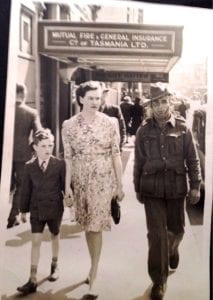
This is my father as a young boy, his mother and her brother (actually her half brother). Nan was very close to her brother Jack, who we knew as Bomber. He lived not far from Nan and he served in WWII and would often send nan postcards and letters from wherever he was serving.
Three more siblings of my nan are Ruby, Jimmy and Max. I have my nan’s photo album and she has many black and white photos of her siblings and nieces and nephews.
Now looking to my mum’s side of the tree where we have lots of photos of sibling groups.
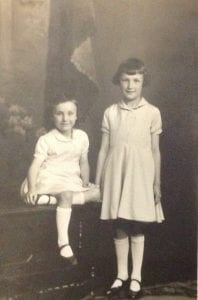
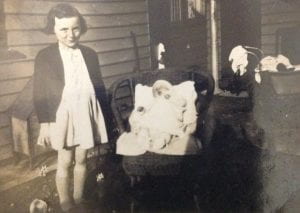
These two photos represent the three England sisters. My aunty Margaret and her older sister Iris who died aged 10, then the second photo is my aunty Margaret with her younger sister Phyllis, my mum who was born a month before Iris died.
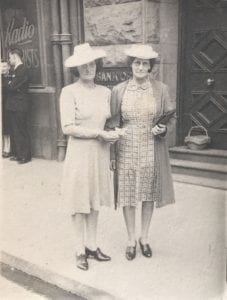
My grandmother Hannah England nee Davey was always very close to her sister Elizabeth Boxhall nee Davey known as Lizzie.
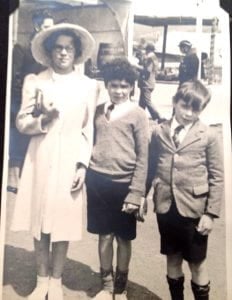
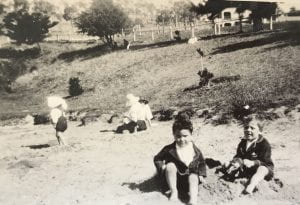
In this photo they even look alike – Hannah on left and Lizzie on right. The two sisters also kept in close touch with their other siblings especially those who lived in southern Tasmania. Hannah and Lizzie would often be together at different events. This photo shows two of Lizzie’s children Reuben and George Boxhall playing on the beach.
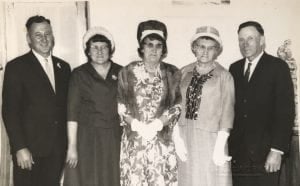
Many of the Davey siblings got together at the wedding of my aunty Margaret in 1949. Pictured above are Frederick, Doris, Hannah, Lizzie and George. Frederick is the youngest of the siblings and was born a month before his father died in 1914.
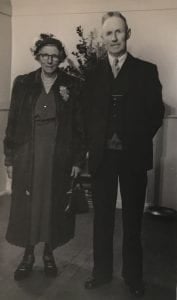
I also have one on mum’s paternal side of her father Henry Lewis England with his sister Ruby May England. This was also taken at Margaret’s wedding.
Readers: How many black and white photos do you have of siblings?
When we first began this journey with dad’s DNA, it was to find out if he had Samoan heritage. Most of his cousins were very dark as were one of their parents with the surname Smith. Yet dad’s mother, Irene, had an extremely pale complexion.
Dad’s mother Irene with her pale complexionRuby’s mother Maddie with her darker complexion
Maybe looking at Ruby’s DNA ethnicity and chromosome browser, I can work out which side is dad’s mother and which is his father.
Parent 1 has the Samoan DNA so this is definitely from Ruby’s mother. The Samoan DNA comes from her father Robert Smith who was one quarter Samoan. Some of the other DNA will be from his wife Nellie Smith nee Somers/Summers/Clark/O’Keefe/Charles who is the common ancestor to both dad and Ruby. Nellie is a problem ancestor as we are unsure of her parents.
What other ethnicities are from Ruby’s mother that match or are similar to dad’s mother?
English/NW Europe – 2, 11, 13, 15
Irish – 1, 2, 3, 4, 5, 8, 12, 16, 17, 18, 20, 22
Scottish – 7
Welsh – none
Swedish – 3, 6, 7, 8, 9, 10, 11, 12, 14, 19, 21
Ruby’s other ethnicities from parent 1 include: Southern Bantu, Tonga, Nigeria, East Polynesia/New Zealand Maori, Benin/Togo and Southern Philippines.
Comparison
As dad’s parent 2 has no Irish at all, yet Ruby’s mum has Irish on 12 different chromosomes, this would suggest that dad’s parent 1 is his mother. Any chromosome ethnicity common to both dad’s mother and Ruby’s mother must come from their mother who is their common parent.
I think this fits well as dad’s mother’s father has mainly Scottish and Irish ethnicity. So that would be the remainder of the chromosomes not fitting with Ruby’s mother.
My next step to continue using the DNAPainter program to paint dad’s chromosomes using results from other databases.
Irene was born 23 July 1909 on Bruny Island as the eldest child of Edward Robert Smith and Irene Ellen Somers or Clark. Through DNA testing, it has been proved that her father was actually a son of Alexander and Hannah Dawson nee Sutton who lived in Queenstown, Tasmania.
Tasmania, Civil Registration of births 1899-1912, Port Cygnet
Irene had 14 younger siblings born between 1910 and 1931. The family mainly lived in Hobart, Tasmania but from 1918-1921 spent some time in Scottsdale, Tasmania where her father was a sawyer.
In early 1932, Irene became pregnant and married William Alan Wyatt on 11 April, later giving birth to her only child Robert Wyatt in November 1932. By late 1934, William (whose first Tasmanian wife had died in September 1931) had deserted Irene and baby Robert, and headed to unknown destination (later found in NSW married for a fourth time).
Irene worked as a cleaner and general housemaid at Heathorns Hotel then later the Albion Hotel. This involved living on the premises, so Robert was looked after by a foster mother for most of the time, Mrs Avery in Goulburn Street, Hobart. Irene did not have much furniture in her little room but there was a small carved black table that is now owned by Robert (Bob). She also had an Hawaiian steel guitar under her bed and many songbooks that she collected throughout the war years.
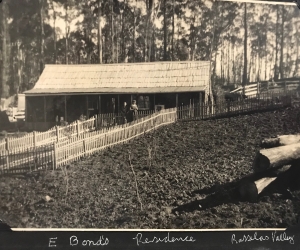
It was while working at Heathorns that Irene met Ernie Bond who lived in a home in the Rasselas Valley near Adamsfield. Irene wrote a diary about her trip on horseback along the track to Adamsfield. This diary is held by her son Bob.
Irene sought a dissolution of her marriage in 1945 due to desertion. A decree nisi was granted on 21 March 1945. A decree absolute was granted in October 1945.
In 1954, Irene married a second time to a Polish immigrant Mikolaj Hrydziuszko, who had arrived in Australia in 1948 after World War II.
Irene and Mike travelled to Japan on a cruise returning with lots of little mementoes. They are buried together at the cemetery in Pontville, Tasmania where many Polish graves can be found.
Memories of Irene
These are from her son Bob (B) and grand daughter Suzanne
Always well dressed and usually wore her hair up high in a bouffant style
Loved going for walks around Hobart
Kept her house immaculately clean and smelling fresh
Went downhill quickly once her blindness stopped her walking everywhere
Took lots of photos of her with her sister Madeline and her children – have her photo album with these
Was concerned about her brother Jack or Bomber as we knew him – he sent occasional letters or postcards often censored by the army (B)
She was a smoker and always smoked Turf cigarettes (B)
Would often call into her parent’s house in Liverpool Street while taking Bob home to his foster mother (B)
Hated picnics, sand, ants, cold! (B)
Had a steel guitar, but I never heard her play it. Did crosswords, I still have her well-thumbed dictionary. (B)
I never saw her really upset. I wagged school and was expelled from Lansdowne Crescent School, sent to St. Virgils, must have cost her a lot. (B)
Mike (her second husband) found she left the stove on, would get up at all hours and wander about. I insisted that she be cared for in a nursing home, it was too much for Mike. Went into a nursing home in Star St. and was well cared for there. Was almost blind, and hated the dog at the home that would come close to her picking up crumbs. Mike used to take her out most days and give her sandwiches. He persevered with her taking her to the domain or the Waterworks. (B)
I used to visit her in the home during my lunch hour when I worked in town. She would be just sitting in a chair. Often told me that no-one ever came to see her even though I knew Mike had taken her out that morning. I confess that I was often in tears walking back to work. She died peacefully in the home. (B)
Ernie Bond’s residence at Rasselas Valley
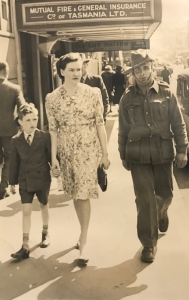
Bob, Irene and Jack before heading off to war
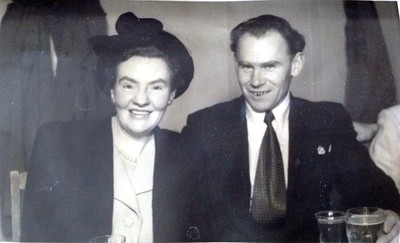
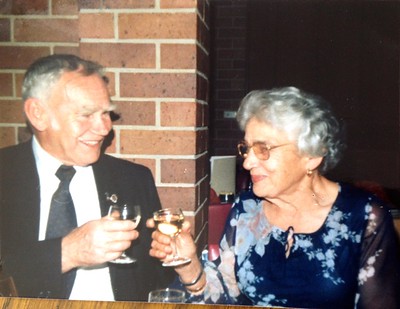
Irene’s birthday with her sister Pat and her husband Eric Gates from Adelaide.