What a challenge!

Mohamed_hassan / Pixabay

My parents and I had often spoken about our family history. Three of my grandparents were alive when I was born but none of my great grandparents. In fact four of my grandparents were alive but I didn’t know that until my parents, my brother and I did DNA tests.

Mum’s DNA matches were lots of her cousins that she knew or who we knew of from family reunions I had helped run back in the 1980’s and were on my database. But there were a few unknown names in Dad’s DNA matches.

Now came the challenge – how were they related to my dad?

Dad’s paternal line should have been the surname WYATT and his maternal line should have been SMITH.

From what I knew of dad’s paternal side, his father had deserted him and his mother when dad was two and there were no other children from the marriage. But his father had been married before and had two children from that marriage. I could find no matches relating to them. Another person with the surname Wyatt but living in New South Wales had been in contact with me and thought her grandfather and my grandfather were the same person. So we had her dad test DNA as well – another half brother for dad. But all my research on the Wyatt name from the paper work we had was getting us nowhere for 20 years until suddenly another DNA match with the surname ALLEN came up as a close match. We worked out he was a half nephew to my dad. His father had the surname Allen and he was older than my dad.  Over 20 years research to work out dad’s father was actually William Elvis Allen and not William Allen Wyatt.

Now Dad’s other challenge was the surname Smith. I had done a lot of research on dad’s supposed grandfather and his father who was a half Samoan whaling captain. But dad’s DNA had no Samoan ethnicity.  So I asked a few of the Smith relatives to test. They all had Samoan and they all matched each other. But Dorothy, who I had met on a bus tour and while chatting worked out we were related through Captain Smith, did not match my dad at all. She matched the other Smith cousins. From this we worked out dad’s grandfather was not the son of the whaling captain but someone else.

The close unknown matches on dad’s DNA came back to the surname DAWSON. After more researching, I worked out dad’s grandfather had been a miner on the west coast of Tasmania at the same time as the Smiths were there woodcutting and whaling.

Below are links to posts I’ve already written about these families.

William Elvis Allen

Alexander Dawson

Captain William Smith

Readers: Have you had both a bigamist and a NPE (non parental event) in your family tree?
More ethnicity at Ancestry

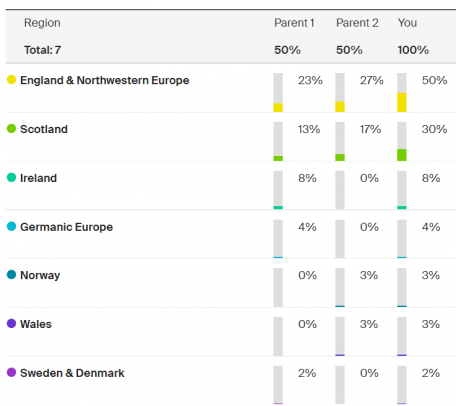
Love the new SideView technology of DNA ethnicity at Ancestry but my problem is that both my parents have passed down very similar ethnicities. Here is the view from my DNA test.

But which parent is mum and which is dad?

Sue DNA ethnicity Apr 2022

With both having large amounts for England and NW European and Scotland, maybe I need to sort it out with the smaller percentages. Sometimes though Ireland is also connected to Scotland so will that 8% help in sorting out which parent?

Luckily both my parents have also tested so I should receive about 50% of their ethnicity – maybe their actual tests will help.

Let’s look at mum’s ethnicity results first:

Mum’s ethnicity from DNA test

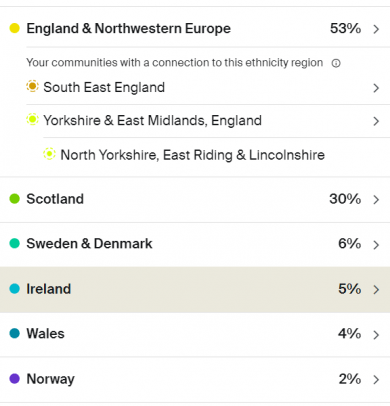
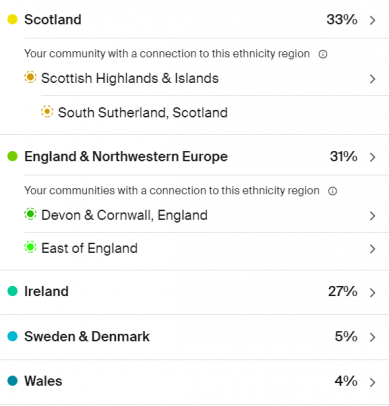
So from mum, I should receive about 27% England, 15% Scotland, 3% Sweden and Ireland, 2% Wales and 1% Norway.

Is this closest to parent 1 or parent 2 on my SideView?

Let’s look at dad’s ethnicity results now:

Dad’s ethnicity from DNA test

So from dad, I should receive about 16% England, 16% Scotland, 13% Ireland, 3% Sweden and 2% Wales

Is this closest to parent 1 or parent 2 on my SideView?

My thoughts

Because of the large Irish percentage in dad’s ethnicity, I think that parent 1 is dad and parent 2 is mum. But what about that 4% Germanic Europe? In earlier versions, dad did have this mentioned as an ethnicity but it is not on the most current version.

I can also try to work out what ethnicity my mum and dad received from their parents as they also have SideView technology done on their DNA tests.

Will it be easier to work out their inherited ethnicity? That is for another post.


Day 3 RootsTech 2022

Knowing I have the rest of the year to look at my playlist, today was a very relaxing day especially as I got up very early (7am in Tasmanian time) to take part in:

Dealing with ethical dilemmas in an online world

Genealogists running the session included Lynn, Jill, Judy, CeCe , Kerry, Daniel and Andrew.

A poll was available at the beginning of the session but as I was a few minutes late joining, I didn’t get to fill it in. The data from the poll was used to lead the discussions.

Topics discussed were:

  • Copyright with photos and records
  • Terms and Conditions on websites we use as genealogists
  • Find a Grave – when and who to add memorials to this site
  • Investigative Genetic Genealogy – law enforcement access to DNA from large databases

Also mentioned in the chat was bullying and gatekeeping, knowledge from amateur or professional genealogists and joining societies and Facebook groups.

Each topic could have been an hour on its own and this was mentioned by many of the 400+ participants in the chat.

When I was teaching and blogging prior to 2011, Edublogger created guide for copyright and images. It has recently been updated for 2021. Even though it says educators, it is relevant to anyone blogging or using social media.

Pexels / Pixabay

Diaries, journals and calendars: Documenting your ancestor’s day to day life – Melissa Barker

Many different types of diaries, journals and calendars

  • Adolescent or teenager diaries – interesting that the example used was one diary used over a 4 year period – could compare what you were doing in previous year on that date
  • War diaries – I have used these for WWI when some of my relatives were in diaries kept by the battalion or similar
  • Work diaries – rarer and hard to find
  • Daily calendars rather than diary or journal – often includes images

These help as a primary resource about what was happening in the family and maybe your family’s part in history.

Try finding them at home, archives and museums. Often mentioned under Manuscript collections. Could also be found in neighbours diaries etc.

I am very lucky in that my parents, whenever they went on a trip away, kept a diary of their travels, including our three month trip around Australia as a family. Dad’s mother also wrote a diary, which dad now has, of her journey to Adamsfield in Tasmania.

Readers: Have you got any diarists in your family? How have they added to your family history?