I would head to Enfield in London in the early 1850’s to chat with my great great grandfather William Chandler. I would ask him about his parents and where they lived, any siblings he had and why he decided to become a gardener.
I would also ask him whether he already knew his future wife Caroline Bryant before he came to Van Diemen’s Land in 1855.
On WikiTree this week, the challenge is from the London Westminster and Middlesex Family History Society. I replied that I would try to help with their research but I also commented that I had a brickwall from Enfield area which is a place covered by the society. A reply from Elizabeth asked could they help me. So this post is about what I know about my great great grandfather.
William Chandler arrived in Hobart Town, Tasmania on 15 February 1855 on board the ship Fortitude. It had sailed from Plymouth on 1 November 1854. According to the arrival record he was aged 22. He was one of 147 immigrants under the bounty system and his passage was certified by John Leake, a large property owner in the midlands of Tasmania. William’s single ticket was number 227. James Axton, ticket number 230, also went to John Leake as a gardener the same as William. He was also from Middlesex, was 23, could read and write and was Church of England like William. Book 5, pages 191-192
George Jobson, his wife and two sons from Yorkshire also went to John Leake’s property as a coachman and general servant. The family were also Church of England.
Caroline Bryant was a worker at Rosedale with Leake family at same time as William Chandler. She took over as housemaid from Susan Green in April 1857. page 216
Had William known Caroline back in London and asked John Leake if he could organize for her to come out as an immigrant? Or did they first meet at Rosedale?
In 1859, William married Caroline Bryant who had arrived with her mother Charlotte on 19 January 1856. They came from London to Sydney on the ship La Hogue then by steamer to Tasmania. The person who applied for them to come out was R.W. Nutt, an important solicitor in Hobart Town at the time. Book 34, pages 203-204
On the marriage certificate for William and Caroline, he was 24 and she was 22. One of the witnesses was R. G Winter who was Caroline’s brother in law and married to Esther Julia Bryant back in London. Esther’s mother Charlotte had applied for her daughter, son in law and his parents to come out to Tasmania. They left London on 7 October 1856, arrived Hobart Town on 29 December 1856 on the ship Woodcote. Pages 18-21
The other witness at the marriage was Emma Minns who arrived also on the Woodcote with her parents and sister.
By the time of his marriage, William was a gardener at Government House and was sometimes mentioned in the diaries of Lady Gore Browne, wife of the governor.
Children of William and Caroline. Might be helpful to find parents and siblings of William if naming pattern followed.
What have I found prior to his arrival in Hobart Town?
1. I have found a William Chandler from Enfield, Middlesex aged 16, unmarried and a gardener lodging with the family of John and Jane Frayne living at Railway Gate House in the district of Edmonton in 1851 English census. The family is still there in the 1861 census but William is not there anymore.
2. There is a possible baptism on 10 Jan. 1835 at St Leonard’s, Shoreditch, Hackney, England
Father John Chandler and mother Mary Chandler nee Youngman??
3. There is a possible baptism on 4 Aug. 1833 at St Andrew, Enfield, Enfield, England
Father Daniel Chandler and mother Mary Chandler nee Chivers??
4. From 1841 census with parents Daniel (a carpenter) and Mary Class: HO107; Piece: 653; Book: 2; Civil Parish: Enfield; County: Middlesex; Enumeration District: 3; Folio: 25; Page: 7; Line: 22; GSU roll: 438772
Hope this information and the links included can help Elizabeth find some more information about William Chandler my great great grandfather.
UPDATE: I was listening to a talk about gardeners in Tasmania and William was mentioned. The speaker Ann Cripps has written a book including a chapter on the Chandler family. I found a library with a copy of the book and this information now takes me to Williams employment back in England.
For two years 1852-1854 William had been working for, and living with William Everett Esquire at Chase Side which was an estate in Enfield.
Over the past few weeks, I have been helping some new cousins work out their matches. I thought I would write a post explaining what I do when I get a new DNA match. You could do something similar the first time you see your DNA match list.
I asked permission from my new cousin Sue E, who you met in a previous post, if I could use her results with my mum. It was after that post that Sue E decided to do a DNA test.
Results Sue E to my mum.
Step 1. Do I recognize the name?
I look at the name. Do I know it? Probably not unless they are near the very top of my list. But in this case the new match’s surname was England which is the same as my mother’s maiden name. So Sue E probably matches through mum’s father’s line somewhere.
Step 2. How much DNA do we share and how are we related?
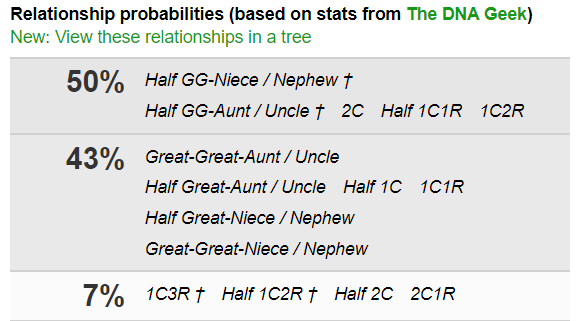
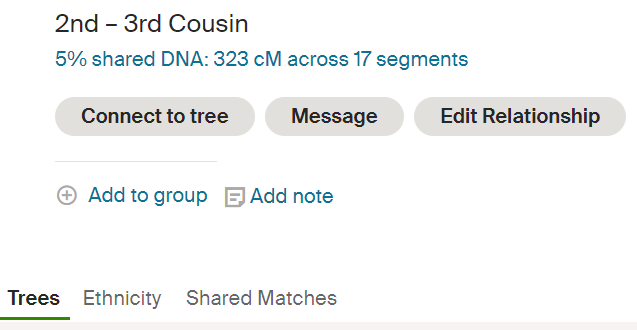
The higher the amount of DNA (cM) we share, the closer the match. Sue E shares 323cM. According to Ancestry, this could be 2nd-3rd cousin. But I always check the Shared cM Project on DNAPainter to see more accurate options for relationship.
Step 3. Do we have common ancestors?
This means there are people on both the trees of Sue E and mum who could possibly be a common ancestor. I notice Sue E has a public linked tree meaning her DNA is linked to her tree and the tree is available to the public on Ancestry. She also shows common ancestors. If there were no common ancestors mentioned, I would still look at the tree. So I click on the common ancestor link (using right click open in new tab) so I now have two tabs open. One with the common ancestor/tree info and one with mum’s DNA match list.
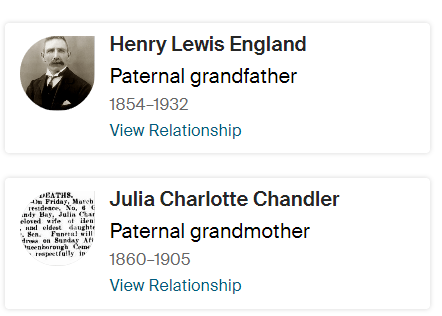
We now see that mum’s paternal grandparents Henry Lewis England and Julia Charlotte Chandler are related to Sue E as her paternal great great grandparents. This would mean mum and Sue E are possibly 1st cousins twice removed 1C2R which is one of the 50% options on the Shared cM Project chart above.
Step 4. Adding to tree
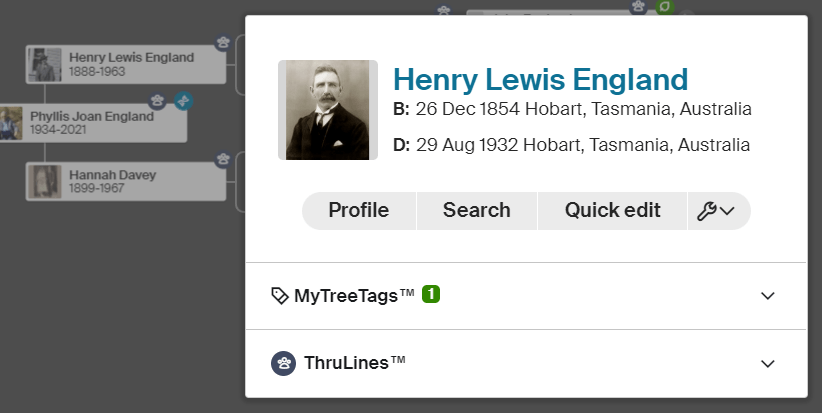
Now knowing where Sue E fits on mum’s tree, it is time to add her to the tree and tag her as a DNA match. So I open mum’s tree in a new tab and make sure it is in pedigree mode. I then click on one of the common ancestors Henry or his wife Julia, Then click on his profile. Notice mum’s father and grandfather were both named Henry Lewis England so I had to make sure I had the correct common ancestor to Sue E.
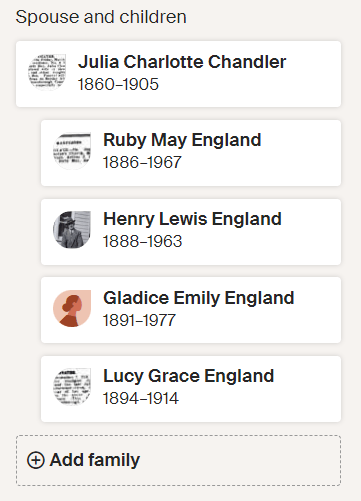
When adding Sue E to mum’s tree, I need to have the information from Sue’s tree showing how she is related to Henry and Julia. I already have that page open in another tab which we had clicked for Common Ancestors. On Henry’s profile page, I have Henry and his spouse Julia, with their four children listed – Ruby, Henry jun, Gladice and Lucy. Looking at Sue’s tree her ancestor is Lucy. So I click on Lucy.
But if I didn’t have Lucy there, I would have clicked on Add family. Then add what I knew of Lucy from the information on Sue E’s tree. Notice, if you click on a person’s name in any tree it will give you the general information of birth and death of that person. If you want more information about that person, you then click on the word Profile. But I don’t need to do that as I only want the basic information about Lucy.
I now click on Lucy Grace England and it will take me to her profile page. Looking at Sue E’s tree the next ancestor I need to add is Lucy’s son Lewis Maxwell England. No father’s name is mentioned so I don’t add a spouse, but I do add family with Lewis’s information from Sue E’s tree. I then click on Lewis to get to his profile page. I now add his spouse and his son Arthur John who is Sue E’s father. This information is again on Sue E’s tree for me to use. I finally click on Arthur John England, add his spouse, add Sue and her brother also known as Arthur John.
Sue E is finally on mum’s tree as are the ancestor connections between Sue E and Henry Lewis England and Julia Charlotte Chandler who are the Common Ancestors between mum and Sue E.
Step 5. Adding DNA tags
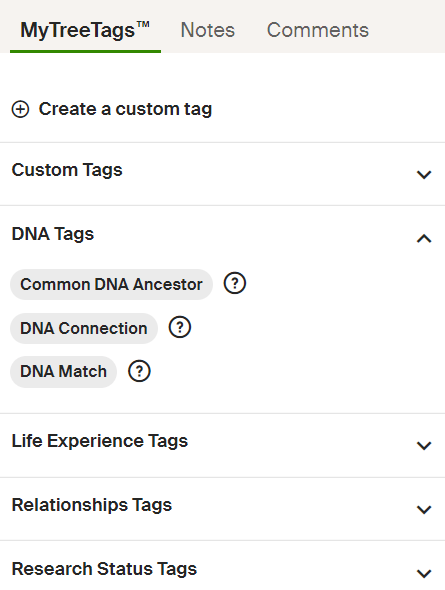
To make it easy for people looking at your tree on Ancestry to know if someone is connected via DNA, they have created special DNA tags. You add these on a person’s actual profile page. There are three of them:
DNA match – this would be Sue E
DNA connection – this will be Sue’s father Arthur John, his father Lewis Maxwell and his mother Lucy
Common DNA ancestor – which will be Henry Lewis England and Julia Charlotte Chandler
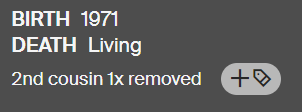
Let’s start with the DNA match Sue E on her profile page. Click on the symbol +tag
This will then open a new side page with a list of tags you can use. Click on the down arrow next to DNA tags and the options will appear.
Sue E is the DNA match to mum so click on that tag. This will now appear under Sue’s name at the top of her profile page. If you make a mistake just click on the incorrect tag in the sidebar and click on the correct one.
Now who are the connections between Sue and Henry and Julia?
Sue’s father so from Sue’s profile page click on her father’s name. This will now open his profile page. The side page with tags should still be open so click on DNA connection.
Who is Sue’s next connection? Her father’s father Lewis. Click on him to get to his profile page and click DNA connection.
The next connection is Lewis’s mother Lucy. Click on her name then click DNA connection for her.
Now Lucy’s parents are Henry England and Julia Chandler. They are the common ancestors between Sue E and my mum, so click on Henry but add the tag for Common DNA Ancestor. Do the same for Julia Chandler.
Step 6. Changing relationship, adding notes and coloured dots
So Sue E is now on my tree, I know she is mum’s 1C2R and I know she is part of the England/Chandler group. I go back to the tab that has the common ancestors and Sue’s tree on it.
I now edit the relationship. Sue is related on mum’s father’s side of tree and she is 1C2R.
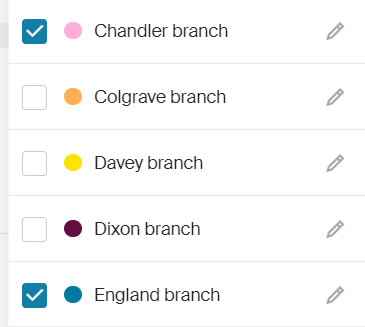
Next I add to group. I create a group called England branch and another called Chandler branch. I then click each of these to add Sue to these groups.
Usually I now add a note reminding me how Sue is related to the common ancestor:
Sue E – her father – Lewis Maxwell – Lucy England – common ancestors: Henry Lewis England and Julia Charlotte Chandler.
These notes will appear on mum’s DNA match list under Sue E’s name helping me when sorting other matches.
Next I connect to tree. This allows me to quickly view Sue E on mum’s tree. It will show a large green tree on mum’s DNA match list, so I know I have added Sue E to the tree.
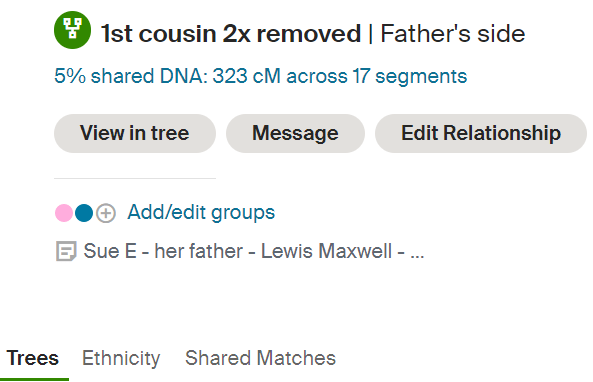
The top of this page has now changed to look like this.
Step 7. Do Sue E and my mum share any matches?
If they do, then those matches should also have the same coloured dots. But remember some people might match you in more than one set of common ancestors. You might have some double cousins – these will have higher amounts of cM shared. If you come from a family with endogamy, then you will have many shared matches. Those matches with low cM might only match on one side of the common ancestors as they go back more generations.
But mum and Sue share 29 matches ranging from 20cM (Ancestry sets this limit showing shared matches) to 3467cM which is my brother. I have worked out where 21 of these matches fit in mum’s tree and have already added them and other information as mentioned in this post.
Finally, here is what I now see on mum’s DNA match list when we look at Sue E. Compare this to the first image on this post which is what I saw when Sue was an unknown DNA match.
Readers:I know this has been a long post but I hope it has helped you a bit when working with a new DNA match.