Z for Zeehan

Zeehan is a mining town on the west coast of Tasmania. The two main indigenous groups were Peerapper and Tommeginne and they lived mainly on the coastal areas.

Abel Tasman explored the west coast of Tasmania and in 1798/1799, George Bass and Matthew Flinders circumnavigated the state and named two of the mountains after Tasman’s ships – Zeehan and Heemskirk.

Tin was found at Mt Bischoff in 1871 then silver and lead in 1882 near Zeehan. Prior to World War One there were 159 companies operating and the town’s stock exchange had 60 members. There were also 20 hotels in the main street of Zeehan ready for the weary miners.

At one stage, Zeehan was the third largest town in Tasmania after Hobart and Launceston. It was also known as Silver City. The Gaiety Theatre could hold 1000 people. The population began declining after World War One and by 1921 there were no working mines in the town.

The population around 1910 was 10,000 and in 2011 the census records 728 people in Zeehan.

Many men who lived on the west coast would mine in various towns throughout their life. Many Zeehanites worked at Mt Lyell in Queenstown/Gormanston during the disaster in 1912.

A committee to form the Zeehan School of Mines and Metallurgy was begun in January 1892. The building was completed in 1903 and is now known as the West Coast Heritage Centre.

Zeehan School of Mines 20171121-053

How does this town come into my family history?

Whenever our family went on holidays to the west coast, we would spend time at the West Coast Pioneer Museum as the Heritage Centre was known back in the 1960’s 1970’s. We loved checking out the different minerals on display but also going outside to look at the mining setup.

Dad loved bushwalking in the area, especially following old train and tram lines which were used to get the minerals and timber to their destinations. One of the first mountains I climbed was Mt Bischoff.

In recent years I have visited the museum to find out more about the mining disasters in the area particularly the Mt Lyell disaster in 1912.
Holidays with friends

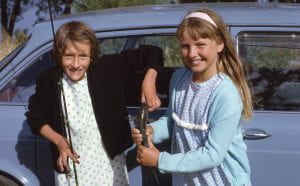
As mentioned in yesterdays post about camping holidays, my brother or I would often take a school friend with us on our longer holidays here in Tasmania.

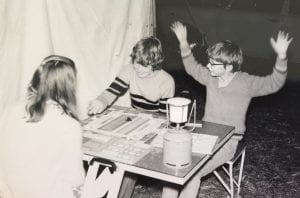
We would go to unusual places, sometimes do things our friends might not have done before and when tired from a long day of physical activities, we would play board games on the picnic table.

Go fishing at Devonport with Robin


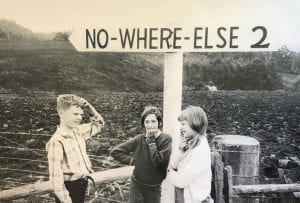
Robin is wondering where we are


Steven beating us at Stockmarket while camping at Coles Bay

But the biggest holiday we went on was our family, Margaret (mum’s sister) and her family when we took off around Australia for three months in 1965.

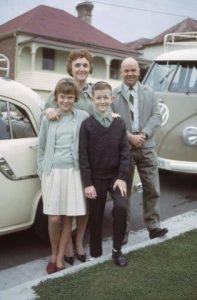
Margaret and Norm PHILLIPS with their children Bronwyn and Leigh getting ready to travel around Australia

Our family used a converted Kombi van, side awning and tent, while Margaret’s husband Norman pulled a caravan behind their car. We went over on the boat to Melbourne, up the east coast to Cairns, then across outback Queensland to the junction of the Barkly and Stuart Highways in Northern Territory, north to Darwin, then back south to Alice Springs.

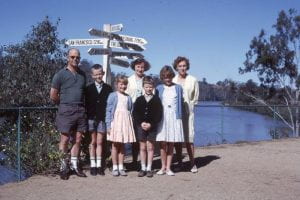
The Mob at the entrance to Lone Pine Sanctuary Brisbane

It was here where the families parted as Marg’s family put their car and caravan on the Ghan to head back to Marree and onward to Melbourne. Our family went to Uluru then back to Alice and the Ghan to Marree where we then spent more time around South Australia before heading back to Melbourne and the boat trip home to Tasmania.

Map of the complete trip Around Australia 1965 11000 miles

Readers: Did you ever go on holidays with other family members or school friends? What was your most memorable holiday?

Foundations of my life

The theme for the month of January is FOUNDATIONS.

To me the foundations in family history are the building blocks of your life. That means family and home.

6 Brent Street in 2021

Our first family home was at 6 Brent Street in Glenorchy, a northern suburb of Hobart at that time but since then it has become a city in its own right.

The home originally belonged to our Uncle Harry (Harry Avery who was dad’s foster father). Harry bought it after his mother passed in 1952 and he and dad lived there.

Dad’s memories of this time:

I remember that Harry let me drive his utility when we went to look at the house there and as we left I backed into a Hydro pole. Fortunately it was only a slight bump with very little damage.

After dad married my mum, it then became our family home.

It was here that my brother, Philip, and I spent our childhood years along with our parents, Bob and Phyl.

Memories of happenings while living at Brent Street:

  • We lived within walking distance of our local shop and not far from the school we both attended
  • There was plenty of room to play in and grass in the backyard to pitch a tent on to sleep overnight if we wanted
  • Room for pets but we only ever had a canary. Sadly he passed away when we were on a holiday around Tasmania
  • Playing board games and doing jigsaw puzzles in the lounge room
  • Long bike rides with our school friends – home to the Botanical Gardens then contact parents when we got there safely and ring again when we were about to leave to come home
  • Birthday parties with lots of school friends
  • Outdoor toilet – just over the passageway from the back door
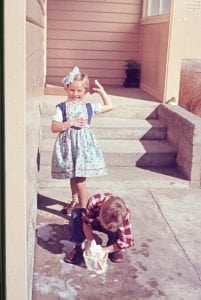
  • Being sent to our rooms when we had done something wrong – I’d read my book so not much of a punishment
  • Drawing on the outside of the house then having to clean it off
  • Lots of bottles along the fence line – fundraising for the Glenorchy Girl Guides and Brownies
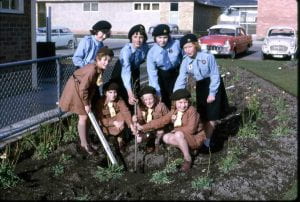
  • As a Brownie, planting rose bush at opening of Glenorchy Council chambers
  • Learning to cook evening meals if mum wasn’t home
  • Family holidays to Devonport, St Helens  and Douglas River – canoeing in canoe dad built
  • Bush walking and camping  around Tasmania as a family
  • Three months travelling around Australia as a family with mum’s sister Margaret and her family
  • Lots of family visiting for birthdays and Christmas – Mum’s family were all very close
  • Visiting Bathurst Street Telephone exchange where dad worked
  • Travelling on the Tasman Limited train with uncle Fred, delivering the mail
  • Sunday school each week and choir
  • Philip at the YMCA

The foundations of my life learnt as a child included being independent, being part of a family as well as groups like Guides and YMCA, having hobbies, consequences of actions, enjoying life as a family and also with friends.


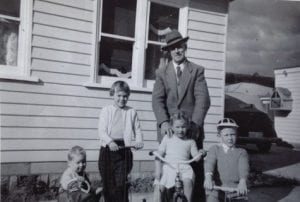
Pa England and his grandchildren Philip, Bronwyn, Sue and Leigh


Sue and Philip washing off the paint on the side of the house, rascals


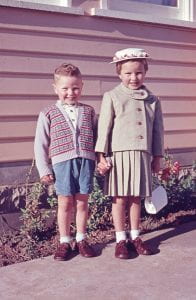
Sue and Philip dressed up at Brent St, probably going to church


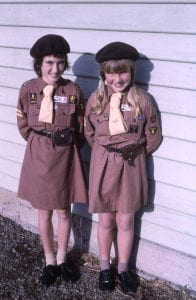
Charmaine and Sue Brownies


Planting rose at Glenorchy Council


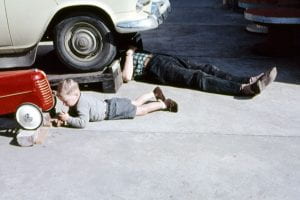
Philip and dad working on their cars

Readers: What would you write about for the topic of foundations?