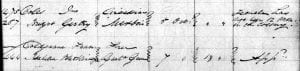
Francis John COLGRAVE junior was the second child born to Francis COLGRAVE senior and Isabella WATKINS(ON). He was born 11 November 1843 and baptised a a month later in the parish of Evandale. Francis’s parents had both been convicts – Francis senior received his conditional pardon on 28 October 1841, Isabella was approved for a conditional pardon on 21 September 1847.
The surname COLGRAVE is also spelled as Coldgrave, Colegrave, Coalgrave, Colgreave in various records.
Francis’s siblings:
The family lived in the Blessington, Deddington and English Town area near Ben Lomond in northeastern Tasmania. In some books, the area was also known as Anamana.
Between 1850 and 1853, Francis senior had a total of 21 convicts working on his property.
In 1861, when Francis junior was 18 years old, a murder occurred at a boarding house which his parents ran in Evandale. Much of this was written up in the local newspaper.
Married life and children
On 19 May 1865, Susan BOYD, aged 20, married Francis John COLEGRAVE, aged 21. They were married at the Manse at Evandale by the rites of the church of Scotland by banns. Witnesses were Catherine Boyd and Samuel Colegrave. Francis John was noted as a labourer in Evandale.
Over the next 20 years, ten children were born to Francis and Susan.
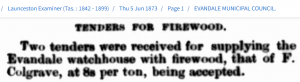
In 1873, Francis is mentioned in the local newspaper or is this Francis senior?
In 1876, Francis junior purchased 69 acres, 2 roods, 27 perches in the area of Blessington. Neighbouring landowners were William Owen, Francis Colgrave senior, Samuel Colgrave, George Robotham and William Kirkwood.
On 13 March 1890, the marriage of Martha Jane to George Davey was held at Francis and Susan’s house. This was according to the Presbyterian church by license.
Francis senior died in October 1890 then his wife Isabella died early in November 1890.
Francis and his son as well as many other Colgrave males were mentioned as supporting Eustace Cameron Esq as their nominated representative for the House of Assembly in 1891.
In December 1892, Francis was one of three nominated as a candidate for the position of trustee for the Evandale Road District.
On 14 May 1895 marriage of Lilian Ada to Charles Davey was held at Francis and Susan’s house. This was according to the Presbyterian church by license. This was the second marriage between the Davey and Colgrave families.
Francis’s wife Susan died on 27 February 1900 at their son Samuel’s residence and registered as living in English Town, Deddington. She was buried at the old English burial ground in Evandale.
In 1903, Francis was again a candidate for trustee of the Evandale Road District.
Francis was mentioned in the Tasmanian Post Office Directories (Wise) in 1913, 1914, 1915 and 1921. He was in these books as Francis Colgrave and his son, also called Francis John, was mentioned as Francis J. They were noted as farmers at Anamana.
In 1913, Francis or his son Francis J, farmer at Blessington, was charged with offering sheep for sale that were carrying ticks.
In 1914, there were 14 people mentioned owning property at Anamana. They were:
- Brown – Adam and Harry – farmers
- Colgrave – Ernest C – grazier
- Colgrave – Francis and Francis J – farmers
- Davey – Charles, George, Harry and William – farmers
- Ede – Charles P – teacher
- Frederick – G – farmer – could be Frederick George Colgrave
- Redburn – Mark – blacksmith
- Loane – Jno – grazier
- Tuck – Jos – farmer
Many Colgrave adults married into the Davey, Brown and Redburn families.
In the 1914 and 1919 electoral rolls Francis and Francis J were noted as farmers in the Blessington area.
In the last 5 years of his life, Francis (Frank) or his son often wrote letters to the Evandale Council asking for improvements to the roads in the area around English Town.
On 26 June 1920, Francis junior passed away at one of his daughters’ residence in Evandale. In his will, he left all his freehold property and buildings to his two youngest sons, Ernest and Frederick. His remains were interred at the Anglican Cemetery, Evandale.
Readers: If any members of the family have any photos I could use in my biographies, it would be much appreciated.